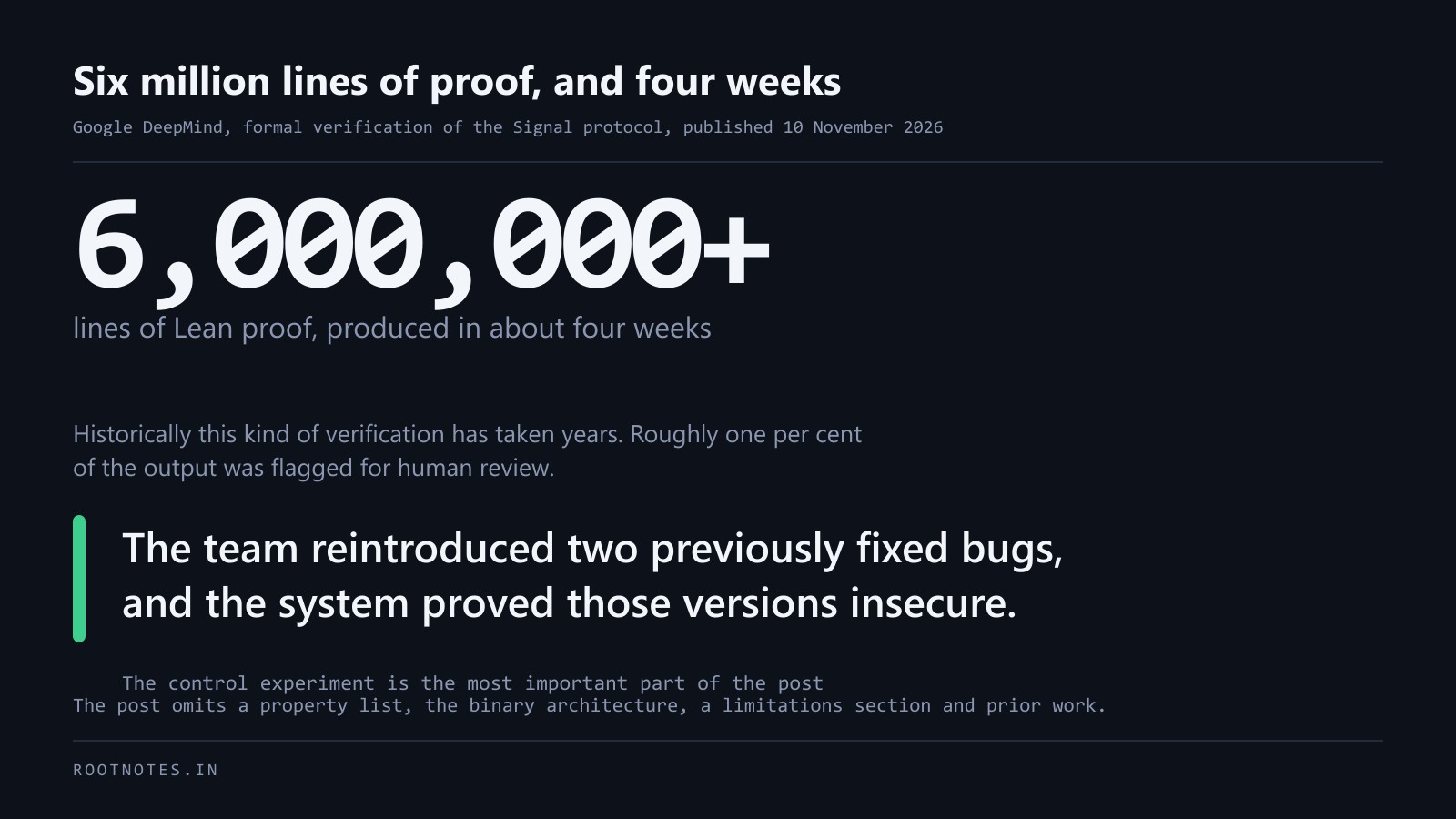
Google DeepMind published work on 10 November proving security properties of the code behind the Signal protocol, using a multi-model agentic system that writes proofs in Lean and has them checked by the Lean kernel.
The headline figures: over six million lines of machine-checked proof, produced in four weeks, against the years DeepMind says comparable work has historically taken expert teams. Agents audited the proofs and flagged about one per cent of the codebase for human review, with Lean checking the rest automatically.
And the claim that makes it interesting: the proofs are about the actual compiled code, not the design. DeepMind's framing is that most protocol verification stops at the design level, while real-world vulnerabilities often sit in the gap between a correct design and its implementation.
The experiment that makes this credible
Here is the part that deserves more attention than the six million.
To test whether the system could tell correct code from broken code, the team reintroduced two previously fixed bugs into an isolated version of Signal's code and ran it again. The system produced machine-checked proofs that those versions were insecure.
That is a control experiment, and it is the difference between a result and a press release.
The failure mode everyone should worry about with automated proof generation is not that it produces wrong proofs. Lean's kernel will reject those. It is that the system quietly proves something weaker than it appears to, by generating a specification that is technically satisfied by code that is still broken. You end up with a genuine, kernel-checked proof of a statement that does not mean what you thought.
Deliberately breaking the code and confirming the system notices is the direct test of that failure mode. It is not a complete answer, because two bugs is two bugs, but it is the right experiment and most people publishing in this area do not run it.
What the page does not say
We read DeepMind's post looking for the specifics that are circulating in coverage of it. Several of them are not there.
There is no full list of the properties proved. The post gives one example, about keeping messages protected before and after a device is temporarily compromised. Secondary coverage lists four named properties. The post does not.
There is no architecture or linking detail. Coverage describes unmodified, statically linked AArch64 binaries. The post refers to compiled machine code and a Lean processor model and does not specify either.
There is no limitations section, and no statement of what is out of scope. Coverage says group chats and key generation are excluded. The post does not say so.
It does not name the prior work it builds on. It says experts have spent decades on formal protocol analysis and that earlier verification focused on smaller portions of code. Coverage attributes specific prior work to the Signal Foundation and a named firm, which, if correct, matters a great deal, because it means the four-week figure describes a continuation rather than a standing start.
We are not suggesting the coverage is wrong. Those details may well come from a technical paper or repository that we did not read for this piece. We are pointing out that the version of this result most people will encounter contains load-bearing specifics that are not in the announcement, and that the four-week number in particular means something quite different depending on what came before it.
What this changes, if it holds
Formal verification has always been correct and almost always unaffordable. The technique is decades old and the reason it is confined to avionics, rail signalling and a handful of cryptographic cores is that it costs more than the software.
If the cost genuinely falls by the order of magnitude implied here, the economics change for a large category of software where a bug is catastrophic but the budget was never going to stretch to proof: protocol implementations, parsers, kernel interfaces, bootloaders, anything handling untrusted input in a privileged position.
That is a bigger deal than most AI security news, and it points the opposite way from almost all of it. Nearly everything we write about automated discovery is about finding bugs faster. This is about being able to state that a specific thing cannot happen.
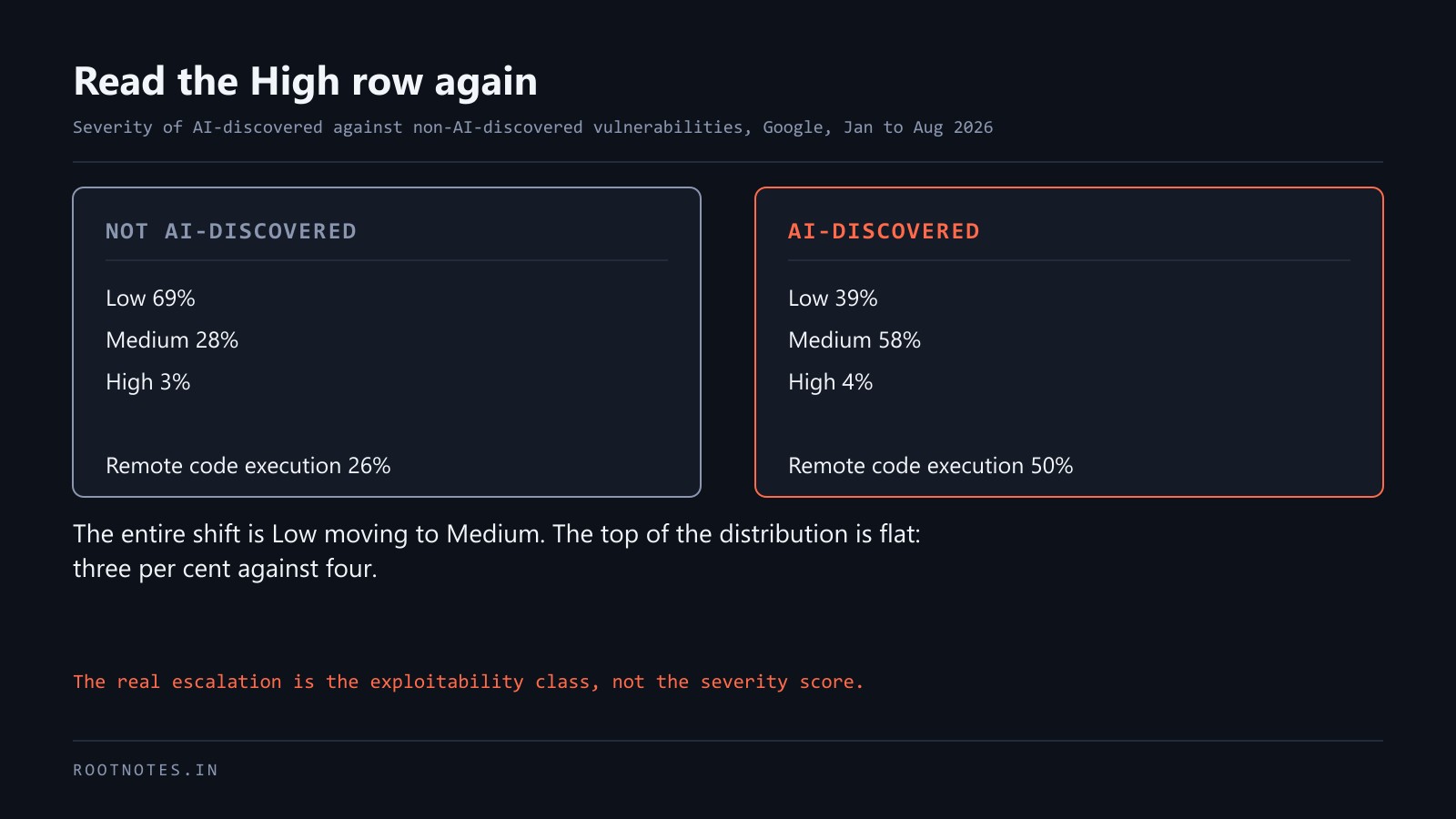
Worth holding alongside the data we wrote about this week: of the vulnerabilities attributed to AI-assisted discovery, half enable remote code execution, and the severity distribution shifted from Low to Medium while the High band barely moved. Finding more bugs faster is a treadmill. Proving a property holds gets you off it.
What is not established
- How much of this is new versus continued. If substantial prior formal verification existed for this codebase, the four weeks is a smaller claim than it reads as. The post does not resolve this.
- What exactly is covered. Without a property list or a scope statement on the page, "key security properties" is doing a lot of work.
- Whether the approach generalises. Signal's protocol code is small, extremely well specified and unusually clean. Most software is none of those things.
- The cost. DeepMind has not disclosed it, and compute cost is the entire question for whether this technique spreads.
- Whether two reintroduced bugs is enough of a control. It is the right experiment at a small sample size.
- The technical paper and repository should be read before anyone relies on the specifics here. This piece is about what the announcement says and does not say.