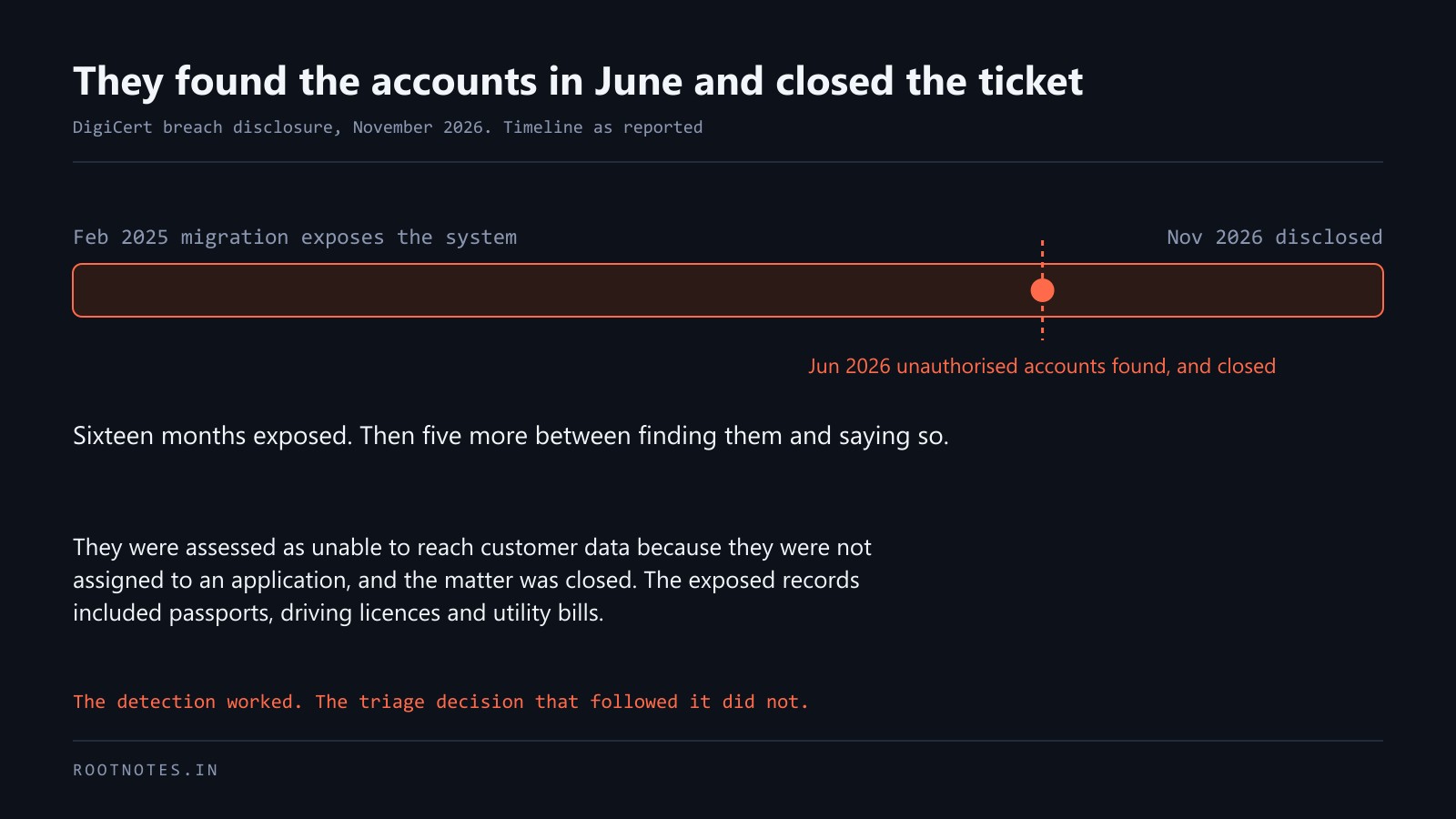
DigiCert has disclosed a breach, and the timeline is the story.
An infrastructure migration in February 2025 accidentally exposed an internal system to the open internet. It stayed exposed for more than sixteen months.
In June 2026, DigiCert found unauthorised accounts on that system. It then determined that those accounts could not access customer information, because they were not assigned to an application.
That determination was wrong. The disclosure came in November 2026.
The failure was not the detection
It is worth being precise about where this went wrong, because the obvious reading is the wrong one.
The misconfiguration is bad and unremarkable. Cloud migrations expose things. Every organisation that has done one has a story like it, and the ones that say otherwise have not looked. Sixteen months is a long time, and the reason it was long is that nobody was looking for it, which is also unremarkable and also true of nearly everybody.
The interesting failure is in June 2026, and it is not a technology failure at all.
Somebody found unauthorised accounts on an internal system. That is the detection working. An alert fired, or a review happened, or somebody noticed something odd. Whatever the mechanism, the organisation successfully discovered that strangers had registered on a system that should not have been reachable.
And then a person looked at it, reasoned that the accounts were not assigned to an application and therefore could not reach customer data, and closed it.
Why that reasoning fails
The judgement was that a permission boundary would hold. Not assigned to an application, therefore no access to application data.
That is a reasonable-sounding inference and it is the specific kind of inference that incident response is supposed to distrust. The accounts existed on a system that was not supposed to be reachable at all. The first assumption had already failed. Reasoning about what the second control would do, from inside a situation where the first one demonstrably did not work, is building on ground that has just been shown to be unstable.
The question that should have followed "there are accounts here that should not exist" is not "can they reach anything". It is "how did they get here, and what else is wrong". Those are different investigations and only one of them finds this.
There is also a specific and unglamorous control that would have answered it: access logs. The subsequent review clearly established that archived records were readable, because that is what is now being disclosed. That same review was available in June.
What was exposed
Most of the affected records held business contact details.
Some also held identity verification documents customers had submitted: driving licences, passports, utility bills, and other documents showing names and addresses.
DigiCert says its certificate authority services, customer login credentials and issued certificates were not affected, which is the thing that matters most about a breach at a certificate authority and is genuinely reassuring. The trust infrastructure held. What leaked was the paperwork people sent to prove who they were.
The company is still reviewing the documents to establish the full scope and has begun notifying affected customers. Reporting notes that the disclosure gives no estimate of how many files were actually copied, which is usually a sign that the logs cannot answer it.
One practical warning
Real DigiCert breach notifications are landing in inboxes now.
That is an ideal condition for phishing, because a message asking a DigiCert customer to confirm their identity is exactly what a legitimate notification looks like this month. Anyone receiving one should verify it through their CertCentral account rather than by following a link, and the irony of a breach of identity documents creating perfect conditions for identity fraud is not lost on anybody.
What is not established
- We did not retrieve DigiCert's own disclosure. Everything here comes through reporting of it.
- The access window is disputed. At least one account gives a narrow window in late June and early July 2026 for the reading of archived records, and we could not confirm it against DigiCert's own statement. Treat the specific dates as unverified.
- How many records, and how many identity documents, were exposed. DigiCert says the review is ongoing.
- How many files were actually copied, as against readable. Reporting indicates this is not established.
- What the June assessment was based on, and whether access logs were consulted at that point. Our reading of that decision is an inference from the sequence as reported.
- Whether the sixteen-month exposure was discovered through routine review, an alert, or an external report.