N-able shipped Hotfix 2 for N-central on 10 November, closing seven CVEs disclosed the previous day.
On 11 November, a researcher published an exploit chain that works against it.
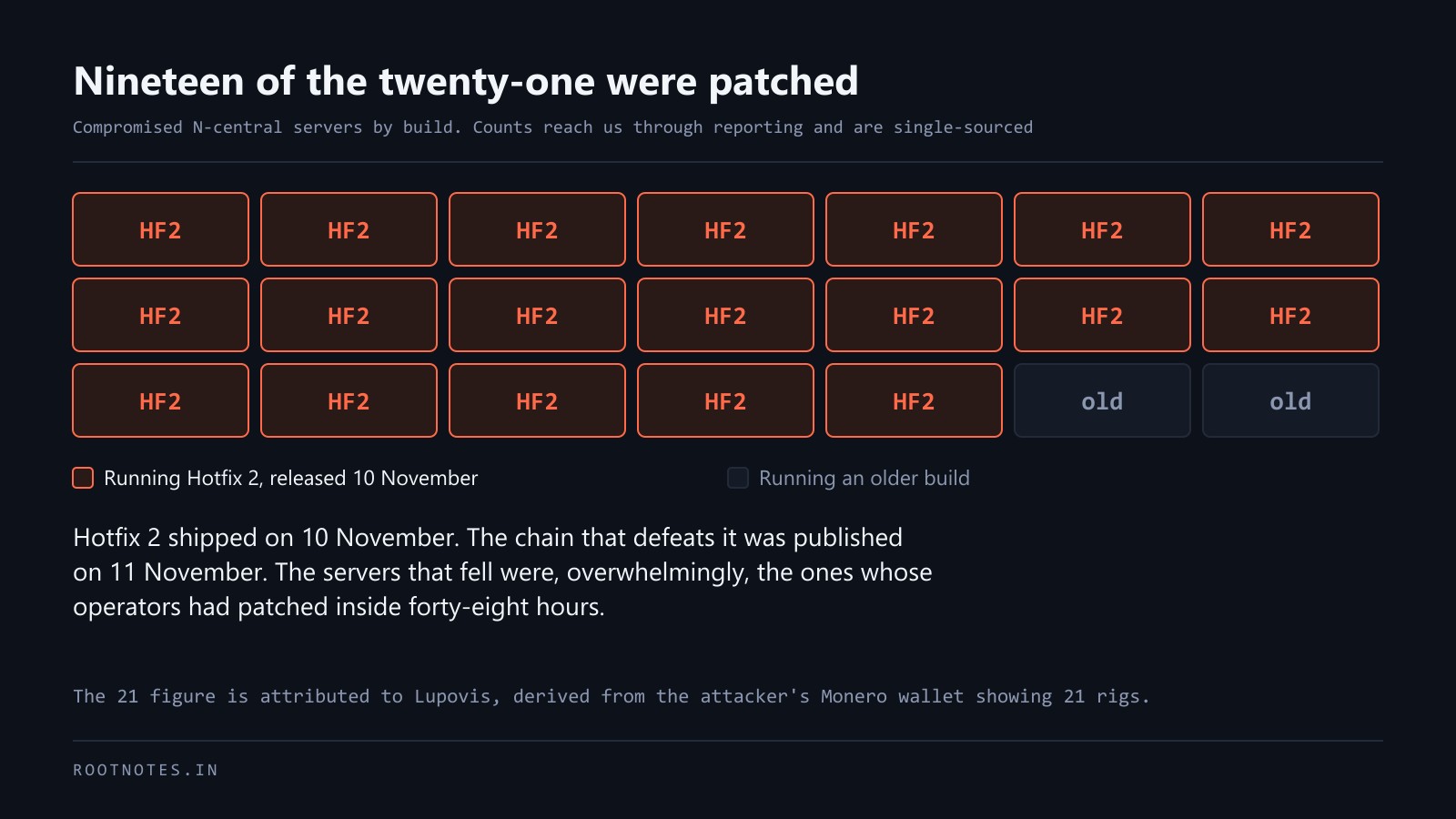
Within hours of publication, attackers were using it. The count of compromised servers reported so far is 21, and 19 of those 21 were running Hotfix 2.
The operators who fell were, overwhelmingly, the ones who had patched inside forty-eight hours. That is fast. In this industry it is exceptionally fast. It did not help.
What actually happened, in order
9 November. A researcher publishes Able2Shell: a set of N-central vulnerabilities reported as 33 issues forming four exploit chains, three reaching remote code execution and one reaching root. N-able takes its hosted N-central environment offline the same day.
10 November. N-able ships Hotfix 2, build 2026.4.1.26, addressing seven CVEs — an XXE, an OGNL injection, a local privilege escalation, a stored cross-site scripting issue, a server-side request forgery, a remote code execution via upload path traversal, and an insecure inter-process communication flaw. Hosted servers are upgraded and brought back online.
11 November. The same researcher publishes two more: 4EverAble2Shell, an unauthenticated chain reaching root on the server itself, and Agent2Shell, targeting the server's communication with managed Windows agents and probes.
12 November. Exploitation begins. Reporting puts the first observed compromises at roughly five hours after publication.
13 November. N-able says it has identified additional indicators of compromise and is working with the affected customers.
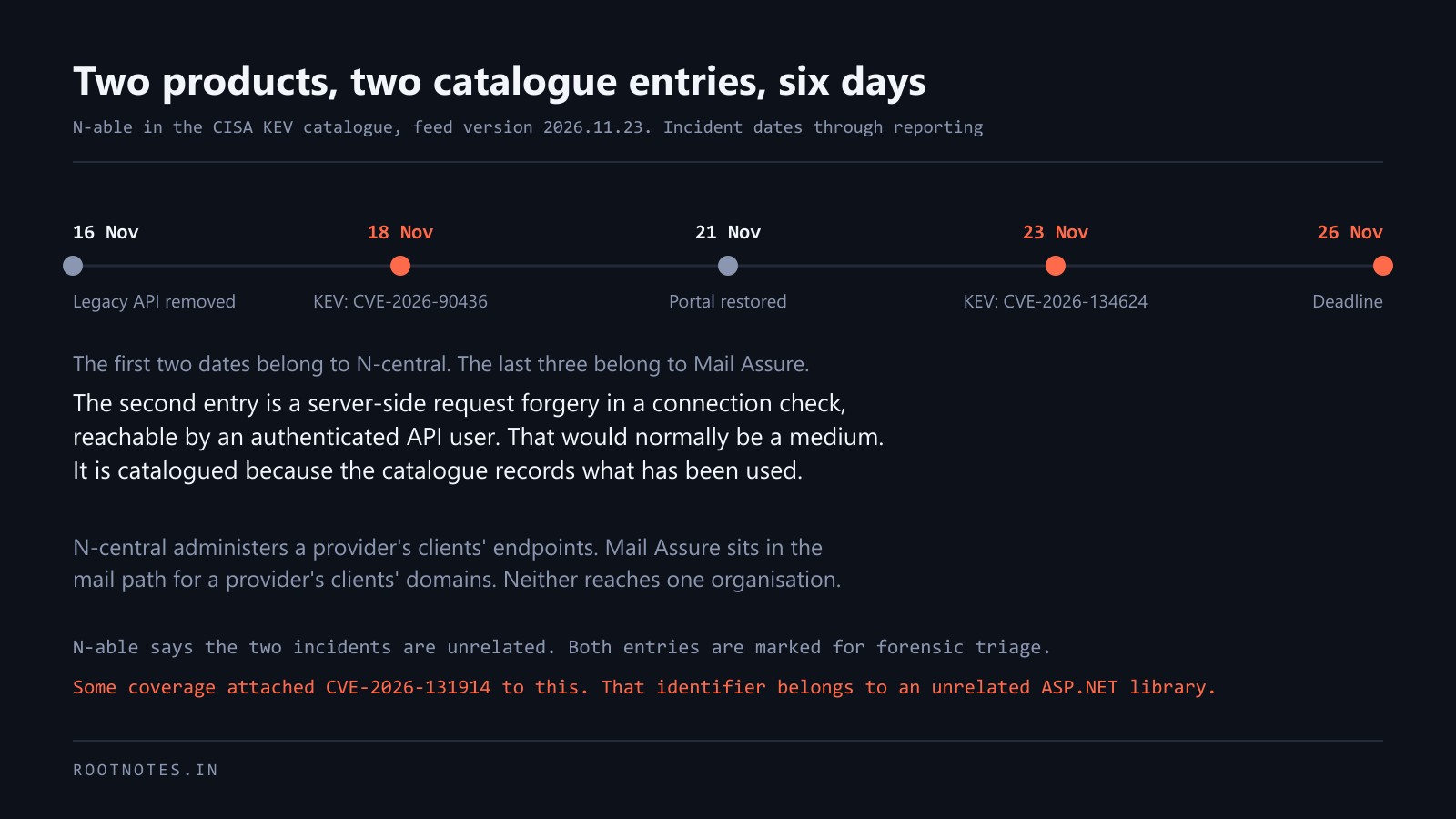
16 November. N-able ships Hotfix 3, build 2026.4.1.39, fixing a further 17 CVEs and removing the Legacy API outright.
18 November. CISA adds CVE-2026-90436, the Apache Axis flaw at the head of the chain, to its exploited-vulnerabilities catalogue, with a three-day remediation deadline.
This is not a patch that failed
It is worth being precise, because "the patch didn't work" is the wrong lesson.
Hotfix 2 fixed the seven things it said it fixed. The new chain reportedly does not go through any of them. It is described as starting from CVE-2026-90436, a flaw in Apache Axis — a dependency, not N-able's own code — to run commands as the service account, then using a separate privilege escalation weakness to reach root.
So the hotfix closed seven doors in a building that had more than seven doors. That is not negligence. It is what a hotfix is: a response to what was disclosed, shipped quickly, before anyone has finished looking.
The problem is that the looking did not stop when the patch shipped. The researcher kept going, found another way, and published it the next day. The defenders' cycle is disclose, fix, test, deploy. The researcher's cycle is find another one. The second cycle is faster, and nothing about patching discipline changes that.
The researcher's own name for it makes the claim out loud. 4EverAble2Shell. Forever.
Where the number came from
This is the part worth slowing down for, because nobody is examining it.
The 21 figure does not come from scanning victims or from incident response engagements. According to SecurityWeek, it comes from the attacker's Monero wallet, which showed 21 mining rigs that researchers linked to compromised N-central servers.
The victim count was obtained by reading the criminal's own accounting.
That is a legitimate technique and a genuinely clever one. It is also a specific kind of number, and it should be read as one. It counts machines that were compromised and successfully installed the miner and successfully reported to the pool. It does not count machines that were compromised and did something else, or compromised and failed to mine, or compromised by somebody other than this actor. It is a floor under one actor's activity, not a measure of the exposure.
Attribution also differs by outlet. The Hacker News credits the finding to a company called Huntback. SecurityWeek credits Lupovis. Huntress, writing earlier in the sequence, said plainly that it had not observed exploitation in its partners' environments, and that the indicators it published came from static analysis of the exploit code rather than from anything seen in the wild. Those statements are not necessarily in conflict — they are different firms looking at different populations at different hours of a fast-moving week — but no single number here has been independently corroborated.
What they had, and what they took
N-central is remote monitoring and management software. It is the console a managed service provider uses to administer its clients' machines. Root on an N-central server is not root on one server; it is administrative reach into every endpoint that server manages.
The attackers used it to mine Monero, throttled to roughly half the available CPU cores to stay quiet.
Hold those two facts next to each other. This is the access that produced Kaseya. What it produced here was a cryptocurrency miner configured not to be noticed.
There are two readings and both are uncomfortable. The optimistic one is that this actor was opportunistic, mass-scanning for a fresh public exploit and monetising whatever it landed on without looking at what it had. The pessimistic one is that mining is the noisy, discoverable thing an actor does on the boxes it does not intend to keep.
Either way, the advice that follows is the same, and the researchers put it well: treat a hit as a full compromise, not a cleanup job. Removing a miner from a machine that an unauthenticated attacker held as root is not remediation.
The bound on all of this
The chain requires the Legacy API to be enabled, and that is not the default. An organisation that never turned it on was not exposed to this particular path.
That is a real limit and it should be stated clearly rather than buried, because the headline number invites the assumption that every N-central operator is a victim. They are not. But the qualifier also cuts the other way: a setting that is off by default is on somewhere, usually for an integration somebody configured years ago and nobody has revisited, and the operators least likely to know their Legacy API status are the ones least likely to be reading this.
How it was actually closed
Hotfix 3 arrived on 16 November, six days after Hotfix 2, carrying fixes for seventeen more CVEs.
It also removed the Legacy API.
That is the part to sit with. Three hotfixes shipped inside eight days. The first two patched flaws. The thing that ended the exposure was not a patch at all — it was deleting the feature the chain depended on.
This is a pattern worth recognising, because it recurs wherever an old compatibility surface meets a modern threat model. The Legacy API existed to keep something working. It was off by default, which is the standard compromise: present for those who need it, dormant for everyone else. That compromise holds right up until someone finds a chain through it, at which point "off by default" turns out to describe a setting that a meaningful number of deployments had quietly turned on and forgotten.
Patching a surface like that is open-ended work, because the surface is old, rarely read, and was written against assumptions nobody has revisited. Removing it is finite work. N-able took six days and two attempts to arrive at the second option, which is faster than most vendors manage.
On 18 November, CISA added CVE-2026-90436, the Apache Axis flaw at the head of the chain, to its exploited-vulnerabilities catalogue with a three-day deadline — formal confirmation, eight days after the fact, of what the mining wallets had already shown.
What is not established
- Everything about the N-central exploitation reaches us through reporting. We did not retrieve N-able's advisory, the researcher's publication, or any of the threat intelligence reports at source.
- The 21 figure is single-sourced and attributed differently by different outlets, and is derived from wallet telemetry rather than from victim-side investigation.
- Whether 19 of 21 running Hotfix 2 reflects the exposed population or the actor's targeting. If the actor scanned for a characteristic common to recently updated servers, the ratio describes the scan, not the patch.
- Whether any of the compromised servers were used to reach downstream managed endpoints. No reporting we found says so, and no reporting we found rules it out.
- Whether Agent2Shell has been used at all. The reported activity concerns the server chain.
- The relationship between the CVEs fixed in Hotfix 2 and the chains by name. The published material does not map them.
- The Hotfix 3 details also reach us through reporting, including the build number, the count of seventeen CVEs and the removal of the Legacy API. We did not read N-able's release notes at source.
- The privilege escalation step still has no CVE that we could find. Only the Apache Axis entry point is catalogued, which means the chain is partially tracked at best.