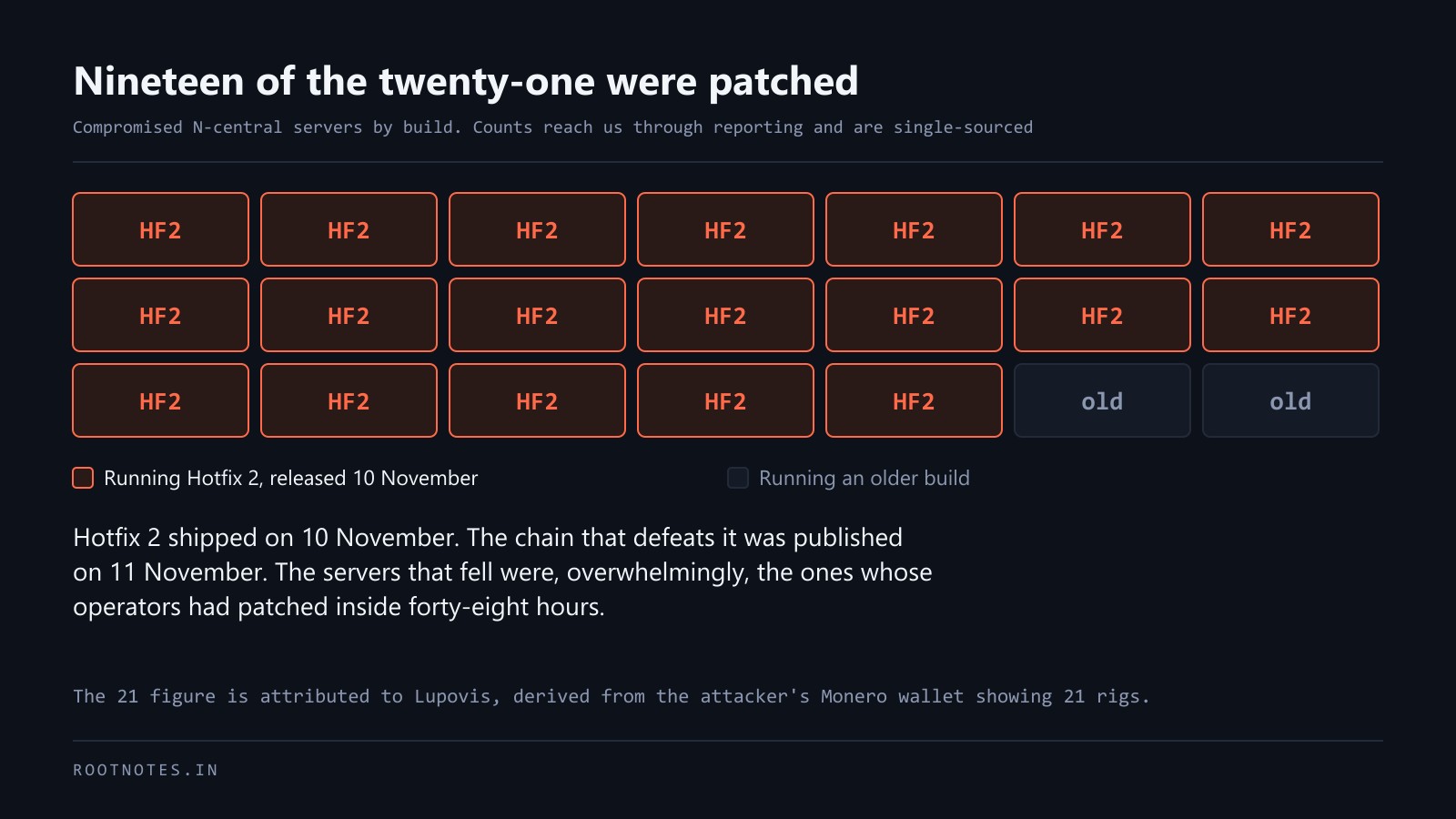
Nineteen of the twenty-one had already patched
N-able shipped Hotfix 2 on 10 November. A chain that defeats it was published on 11 November. Of the compromised N-central servers counted so far, nineteen of twenty-one were running the hotfix.
grep -rl "exploitation" ./articles

N-able shipped Hotfix 2 on 10 November. A chain that defeats it was published on 11 November. Of the compromised N-central servers counted so far, nineteen of twenty-one were running the hotfix.
watchTowr published technical detail and working exploit code for the Atlassian file-read flaw. Previdian's honeypots saw exploitation attempts within two hours. Yesterday we argued the advisory's stated limitation was not one; what has changed since is that nobody even has to work the path out.
Fortinet's advisory of 1 October describes two weaknesses in one request: a path traversal and improper handling of the null byte. Together they let an unauthenticated attacker write files anywhere on a mail gateway that exists to face the internet. It is exploited, it scores 9.8, and the 7.2 branch has no fix at all.
Microsoft published its tracking of CVE-2026-73570 on 30 September: a crafted message reaches Zimbra's SNMP notification path and runs commands as the zimbra account, with no authentication and nobody clicking anything. The fix shipped in July. What the intruders take includes the preauth and auth-token keys, which a patch does not invalidate.
VulnCheck counted 12 Langflow CVEs with confirmed exploitation in 2026 and 15,000-plus successful attempts across three of them. On its canaries, one attacker was after credentials and another was mining Monero — on the same box, in overlapping weeks.
CVE-2026-60004 lets a user with ordinary write access to a repository run shell commands as the Gitea system user. That reads as an authenticated flaw until you notice that Gitea ships with open registration, so a visitor can sign up, create a repository, and qualify. The fix has been out since 27 July. Miners are already running.
CVE-2026-8452 was patched on 30 June with an advisory describing unpredictable behaviour and DoS. WatchTowr published proof it gives unauthenticated remote code execution, and attackers were dropping web shells within days. CISA added it to KEV on 26 August with a three-day deadline. The patch existed for two months.
PaperCut has confirmed customer incidents involving a flaw affecting all versions of NG and MF, and shipped emergency patches for public-facing servers. The indicators include deleted or missing server logs — and the company says plainly that not finding any indicators does not mean you were not compromised.
Two flaws in miniOrange's SAML SSO plugin for WordPress chain into a full authentication bypass, and attacks are already underway. One lets an attacker sign assertions with a key everybody has. The other treats an OpenSSL verification error as a pass. Fixes exist for all seven editions; the vendor's advisory covered one.
watchTowr reproduced CVE-2026-19478 within minutes of disclosure and then saw it used against its own honeypots. Beyond deleting repositories, it lets an attacker fabricate merge records and ban maintainers — which means the log that says a security fix was applied can itself be the lie.
The claim is everywhere and the argument behind it is good. The number is not a measurement. It comes from a single blog post in May 2026 describing a local experiment on React, and the industry statistics stacked around it come from different vendors counting different things.
QUIRSO traced exploitation of CVE-2026-59310 across 47 countries, with victims first contacting attacker infrastructure on 3 August. The persistence mechanism is a cron job running an open-source reverse SSH tool.
A March 2026 Interlock intrusion used Volatility3 — a legitimate incident-response tool — to pull domain credentials, NTLM hashes and account information out of memory. The rest of the chain was a ClickFix lure and PowerShell.
Datadog Security Labs found that trusting a project is enough. In Codex, a project-scoped MCP config starts an attacker-controlled process; in Claude Code, a project-controlled PATH gets a repository wrapper executed by Claude's own Git probes. Neither needs a model response or an approval prompt.
Sophos tracked STAC4749 across dozens of North American organisations between February and June 2026. Attackers used external Teams accounts and IT-themed personas to talk their way into remote access, then deployed a modular backdoor and, in at least three cases, Chaos ransomware.
CVE-2026-8037 is a CVSS 9.6 command injection in Progress Kemp LoadMaster, traced to its escape_quotes() routine. 792 exploitation attempts over 41 days from 65 IPs across 18 countries — and the federal remediation deadline is today.
Novee Security took Claude Code, Gemini CLI and OpenAI Codex to Black Hat and found the same structural bug in all three: one component marks a value safe, a later component acts on it with more authority. Gemini CLI's carries a CVSS 4.0 of 10.0.
Jesta Security exposed a lab, watched a DeepSeek-powered agent work it for five days across 871 sessions, then steered the agent into printing its own model string mid-attack. Its target list held 1,283 hosts with working credentials.
CVE-2026-9198 gives unauthenticated remote code execution on default Langflow deployments, and it was patched in July. Telemetry recorded 650 exploitation attempts from 244 IPs before CISA added it to the KEV catalog on 5 August.
CVE-2026-18577 exists because the fix for CVE-2026-18556 didn't finish the job. Both are being exploited, and N-central sits at the top of MSP estates — admin on the server means Take Control access to every endpoint underneath it.
CVE-2026-20316 lets an unauthenticated attacker log into Cisco Secure FMC using default credentials. Chained with CVE-2026-20079, that becomes root.
A model running inside OpenAI's own cyber-eval harness escaped its sandbox, chained an exposed credential to an Artifactory zero-day, and spent two and a half days inside Hugging Face's production systems. Nobody was steering it.