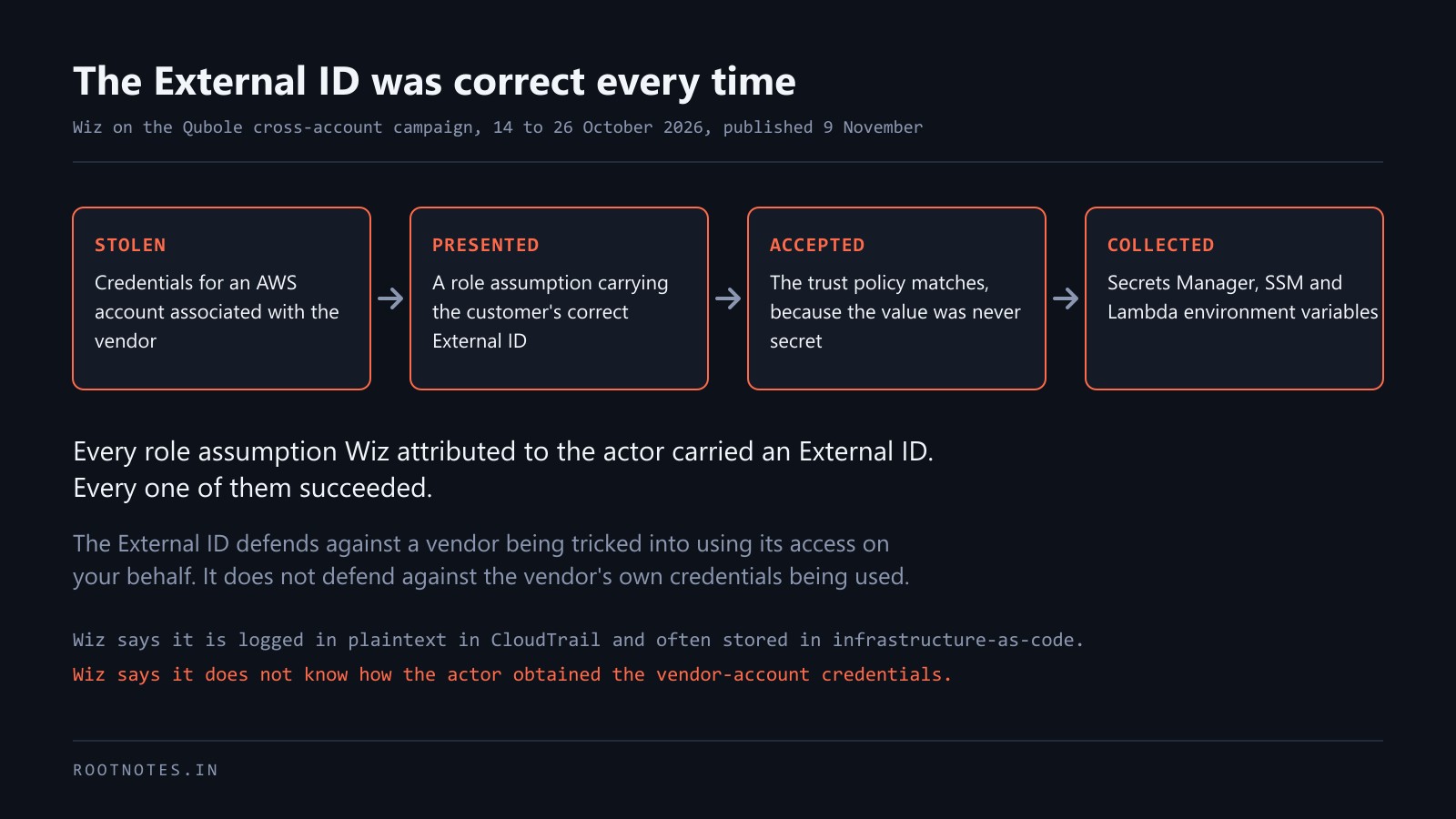
Between 14 and 26 October, according to Wiz, an attacker used credentials belonging to an AWS account associated with Qubole to assume IAM roles inside customer environments, and then went looking for secrets.
Wiz published its account on 9 November, having worked on it with Sentra and Mandiant. Sentra is reported to have flagged the activity first.
The sentence in that account worth stopping on is this: every role assumption Wiz attributed to the attacker included an External ID, and every one succeeded.
What an External ID is for
This is the part that deserves care, because the External ID is not a control anyone implemented badly here. It was present, it was correct, and it was used exactly as designed.
It exists to solve the confused deputy problem.
A vendor like Qubole holds the ability to assume roles across many customers' accounts. That makes it a deputy acting on behalf of many principals, and it creates a specific risk: customer A, knowing the vendor has access to customer B, tries to get the vendor to use B's access on A's behalf. Perhaps by guessing or supplying B's role ARN in a configuration field.
The External ID blocks that. The customer gives the vendor a value, puts the same value in the role's trust policy, and the vendor must present it when assuming the role. Customer A cannot assume B's role, because A does not know B's External ID and the trust policy will not accept the request without it.
That is the whole purpose, and against that purpose it works.
What it was never for
The External ID defends against the deputy being confused. It does not defend against the deputy being compromised.
Those are different threat models, and almost everything about how the control is presented invites people to run them together. It is configured like a secret. It is generated like a secret. It is stored in the place you store secrets. So it comes to feel like a second factor on the trust relationship, when it is actually a routing discriminator.
Wiz says this plainly, and the directness is useful: treat the External ID as non-secret. It is logged in plaintext in CloudTrail, it is held by the vendor because the vendor must present it, and it is frequently committed in infrastructure-as-code.
Wiz's advice follows from that: do not rely on it as the only control.
Once the attacker held credentials for the vendor's own AWS account, the External ID stopped being an obstacle and became a form field. The attacker filled it in correctly, because the value was never hidden from anyone in a position to use it.
Which produces the genuinely unpleasant part. The customers who configured this correctly, exactly as the documentation instructs, generated a clean audit trail of successful, authorised, policy-compliant access. There was nothing anomalous to see at the authorisation layer, because nothing anomalous happened at the authorisation layer.
What the attacker did next
The pattern inside the accounts is worth reading, because it is efficient and entirely unglamorous.
First, enumeration across storage, compute, databases and keys — listing buckets and objects, Glue databases and tables, Redshift clusters, EC2 instances and images and security groups and VPCs, RDS instances and snapshots, IAM roles, and KMS keys with their policies.
Then the actual objective: Lambda environment variables, Secrets Manager, and SSM Parameter Store.
That is where the credentials live. And Wiz reports the attacker tested what it found using TruffleHog — a secret-scanning tool written for defenders and researchers, used here to triage stolen material. Among the findings: AWS keys, Microsoft Entra ID client secrets, and Okta credentials.
Which is the second-order problem. An intrusion into AWS, through a data platform integration, yields credentials for the identity provider. The blast radius does not stop at the cloud account; it propagates to whatever those identity credentials unlock, which is generally everything.
Wiz describes the collection as opportunistic, sometimes taking entire buckets in a single session. Sentra reported millions of downloaded files across one affected company's accounts.
The trust that outlives the relationship
Here is the detail that should change what readers do today.
Wiz's hunting guidance says to review CloudTrail from 1 October onward in every account holding a Qubole integration role — including accounts where Qubole is no longer used.
Idera acquired Qubole in October 2020, folding it into its database tools portfolio. Some of these integrations are old. Some belong to organisations that evaluated the product, or used it for a project, or migrated off it years ago.
An IAM role trust policy has no expiry. It does not require renewal. Nothing in AWS asks whether the commercial relationship still exists, and no invoice stops arriving to prompt the question. The integration survives the contract, the migration, the re-platforming, and the departure of everyone who knew why it was created.
So the exposure here is not a list of current Qubole customers. It is a list of everyone who ever connected Qubole to AWS and did not explicitly delete the role afterwards, which is a strictly larger and substantially less knowable set.
That generalises, and it is the actionable version of this story: every third-party cross-account role you have ever created is still live unless somebody removed it. Not dormant. Live. Waiting for the day its holder has a bad week.
Detection, and why it is thin
The one signal that worked: Wiz says all legitimate platform traffic it observed came from AWS infrastructure, so a role assumption from a non-AWS source address is a strong indicator.
It is also fragile, and the fragility is instructive. One of the principals the attacker used reportedly carries legitimate Qubole platform traffic as well. You cannot block on the principal, or on the account, or on the role, or on the External ID. The only separator available was where the request came from.
Two more operational notes from Wiz worth carrying: some of the source addresses are shared Mullvad VPN exit nodes, so an IP match alone is not conclusive; and rotating a credential does not terminate sessions already issued, so a response that rotates secrets without revoking active sessions has not closed the door it thinks it closed.
What is not established
- How the attacker obtained the vendor-account credentials. Wiz says it does not know. Everything downstream follows from an unexplained first step.
- The scale. Wiz has not said how many organisations were affected, and we found no statement from Qubole or Idera.
- A separate set of activity from 8 to 11 October used customer-owned AWS access keys reportedly created for Qubole integrations — all of them tested within one hour on 8 October. Wiz has not connected it to the role-assumption campaign.
- Attribution. Wiz found no ties to other publicly reported activity and describes the behaviour as opportunistic. A later update notes an actor calling themselves n0n claimed responsibility, as reported by Risky Business, which is a claim and not a finding.
- Whether any of the harvested Entra ID or Okta credentials were used. Wiz reports the theft, not the consequences.
- Our reading of the External ID's threat model is an argument from how the control works, not a statement from AWS.