On 5 November OpenAI announced GPT-6 Cyber and classified it Critical in cybersecurity under its Preparedness Framework, up from High for the previous cyber model. The announcement is specific about what the model has already done, and one claim in it is checkable against a public document.
Here is the claim, in OpenAI's own words. During a vulnerability research campaign the model "produced evidence and reproducible tests for 81 novel vulnerabilities classified by Mozilla as high severity, and showed that an additional 30 known issues were more severe than previously reported". OpenAI says it disclosed the findings with proposed patches, that Mozilla "was supportive of this work", and that Mozilla "began landing fixes shortly after receiving the reports".
So we went and counted the credits.
What is in the advisory
The Firefox release where those fixes landed is Firefox 159, published on 27 October, documented in Mozilla Foundation Security Advisory 2026-118.
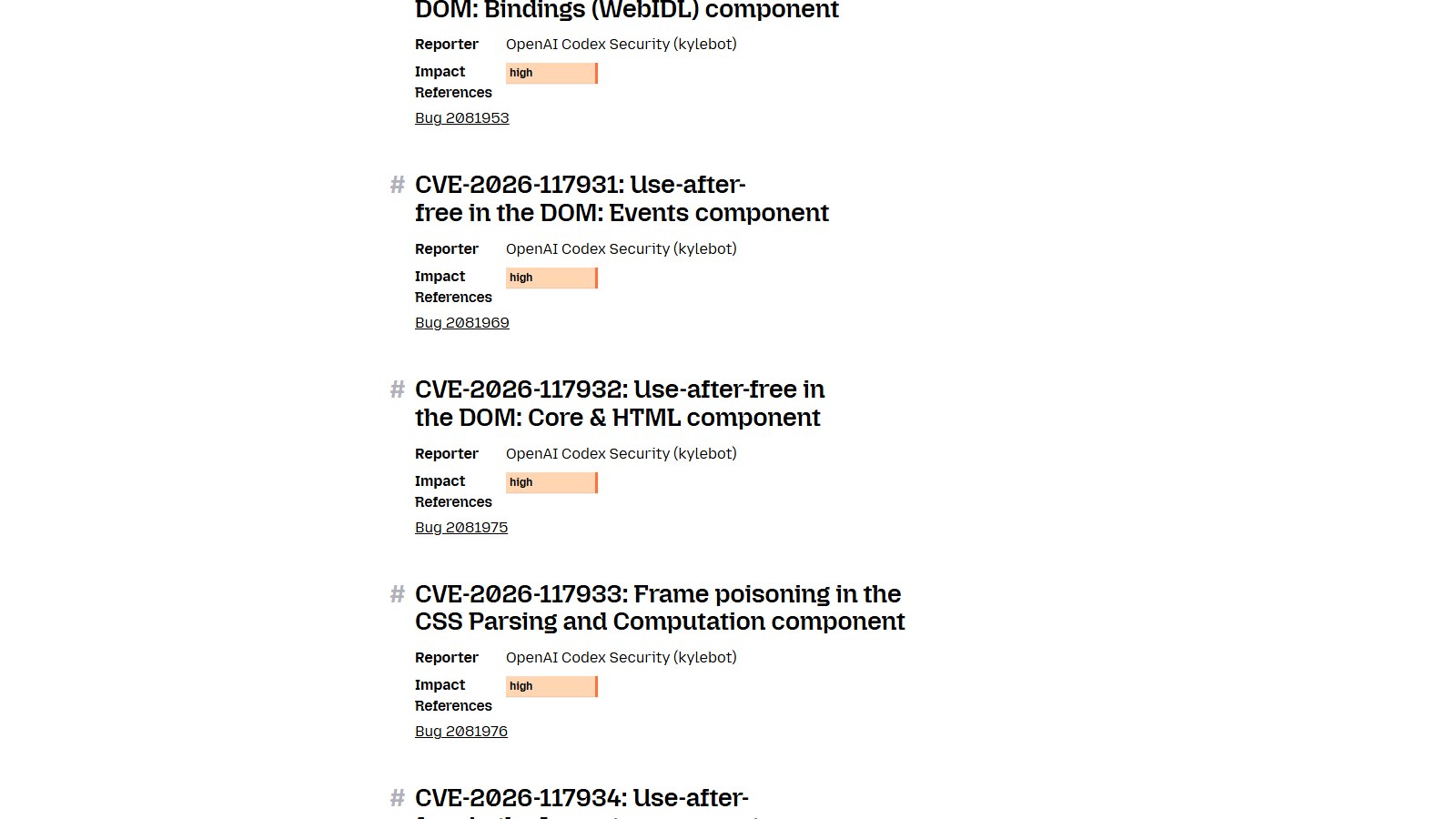
That advisory carries 167 CVEs. Not 17. One hundred and sixty-seven, in a single Firefox release, split 108 high, 52 moderate and 7 low. Of those 167, OpenAI is credited on 41:
| Credit, exactly as Mozilla writes it | CVEs |
|---|---|
| Amy Burnett of OpenAI | 7 |
| OpenAI Codex Security (kylebot) | 34 |
| Total | 41 |
Every one of the 41 sits in the high-impact group, so OpenAI accounts for 38 percent of the 108 high-severity CVEs in the advisory. That is a very large contribution to one release by one organisation, and it is worth saying plainly before the arithmetic that follows.
The arithmetic is this. OpenAI describes 81 novel high-severity findings and 30 re-ratings, which is 111 findings. Mozilla's advisory credits OpenAI with 41.
The next Firefox advisory is MFSA 2026-123, Firefox 159.0.1, published 3 November. It contains exactly one CVE, and that one is credited to Mozilla. There is no later Firefox advisory at the time of writing.
So 40 of the 81 have not appeared in a Mozilla advisory with an OpenAI credit on it. Just over half have. OpenAI's own word is "many", not "all", and on the public record many turns out to mean about half.
The part that matters more
Now read the advisory the way a Firefox user would.
The credits say "Amy Burnett of OpenAI" and "OpenAI Codex Security (kylebot)". One is a named researcher, the other is a team handle. Nowhere does the advisory say that a model found anything.
The whole weight of OpenAI's announcement rests on the idea that a machine did this work. At the point where that work becomes public record, the machine disappears and what remains is a company name and a person's name. There is no field in a Mozilla advisory for how a bug was found, and so there is no way for anyone reading the advisory later to know.
That matters beyond this one release. Amy Burnett is a browser exploitation researcher with a long record of her own, which makes the seven credits in her name genuinely ambiguous: they may be her work, the model's work, or both, and the document does not distinguish. Multiply that across every vendor that will receive model-assisted reports over the next year and the public vulnerability record stops being able to answer a question people will want answered, which is how much of this is now machine-found.
The number nobody mentioned
The 167 is a story in itself. A Firefox release usually fixes somewhere between ten and thirty CVEs. This one fixed 167, and 34 of them arrived under a single handle.
Whatever else is true, a workflow now exists that produces findings faster than the format built to publish them was designed for. The advisory reads like a list that ran long.
Also in the announcement
Three things in the post deserve more attention than they have had.
The Linux numbers. The model reproduced 1,724 vulnerabilities and built working exploits for 948, which OpenAI notes is more than five times the 166 managed by the previous model on the same harness. Of those 948, OpenAI says it disclosed 304 critical findings to maintainers with candidate patches and is "in the process of getting other vulnerabilities fixed". That is 32 percent disclosed.
The operational technology finding. In a customer quote, Dragos says it put a frontier model on a mock power plant range and the model "found two zero-days in engineering software that manages protective relay data, exposing protection settings and breaker trip logic". Two previously unknown flaws in software that governs when a breaker trips, reported inside a pull quote in a product announcement.
The scope numbers. On an evaluation designed to see whether the model attacks things it was not asked to attack, it stayed in bounds in 99.93 percent of runs without a safety prompt, up from 94.49 percent. The improvement is real and large. The remaining figure is seven runs in ten thousand.
What is not established
- Whether the other 40 findings are fixed but uncredited, fixed in a branch advisory we did not read, or still open. Mozilla's index shows no later Firefox advisory, and that is all it shows.
- Whether Mozilla's crediting convention is a deliberate editorial choice or simply the shape of its advisory tooling. We did not ask Mozilla.
- Which of the seven findings credited to Amy Burnett were model-assisted. The advisory does not say and neither does the announcement.
- Whether 167 CVEs is a record for a Firefox advisory. We did not read Mozilla's full history.
- Whether the two operational technology zero-days Dragos describes have been reported to their vendor or assigned identifiers. The quote does not say, and we did not read Dragos's own report.
- Whether any of OpenAI's benchmark results have been independently reproduced. At the time of the announcement, none had been published.