OX Security published research on 23 November 2026 covering 542,207 components across npm, PyPI, Model Context Protocol servers and Agent Skills, from findings collected between July and October.
One pair of numbers in it is worth the whole report.
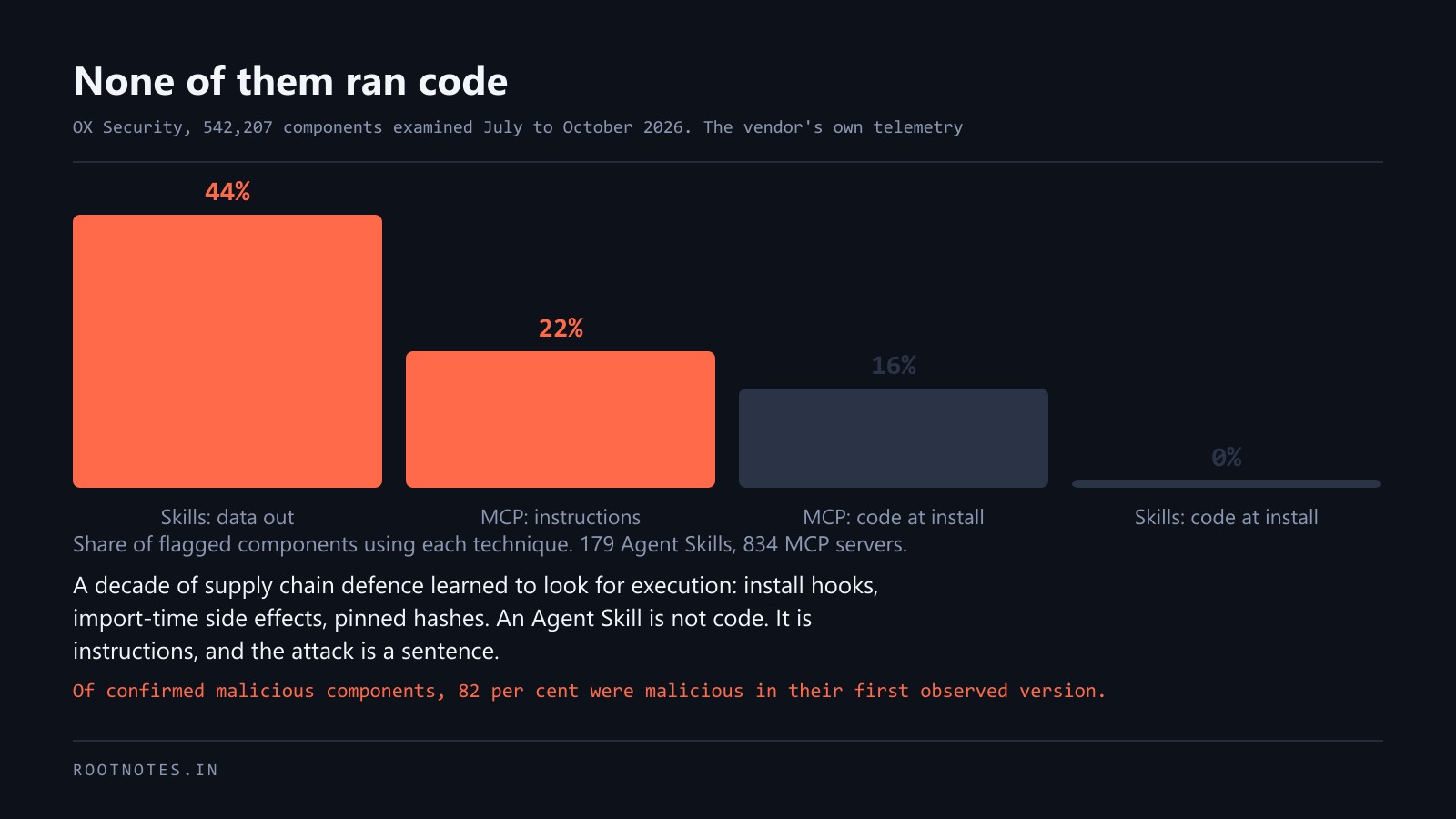
Of 179 flagged Agent Skills, the number that executed code at install was zero. The number that instructed the agent to send data out was 44 per cent, which is about seventy-nine of them.
Why that pair matters
Software supply chain defence has spent a decade learning to look for execution.
Install scripts. Import-time side effects. Postinstall hooks. The reason package managers grew a flag to refuse install scripts, the reason build systems run in sandboxes, the reason a lockfile pins a hash, is that the attack was code that ran when you were not looking.
An Agent Skill is not code. It is instructions. The attack is a sentence.
A scanner that reads a package for executable behaviour finds nothing in a skill that says, in plain prose, to collect the contents of a directory and post it somewhere. There is no hook to disable, no sandbox to confine, and no hash to pin that would help, because the hash is of the malicious text.
OX's own framing is the cleanest statement of it: a poisoned tool can instruct an agent to act on the attacker's behalf, and the agent already has the permissions.
The same pattern, weaker, in MCP servers
In flagged MCP servers, prompt injection and tool poisoning appeared in 22 per cent, against 16 per cent showing install-time or import-time execution.
In flagged npm packages, the ratio reverses: execution techniques were six times more common.
So the shift is not universal. It tracks what the component is. An npm package is code and is attacked as code. An MCP server is a tool description plus a service, and is attacked through the description. A skill is only a description, and the execution route disappears entirely.
That is a clean gradient and it predicts where to look next.
You cannot check what the server runs
The second finding is about verification rather than intent.
Of 834 flagged MCP servers, OX reports it could not independently confirm the code for 83 per cent. Of those, 67 per cent run on infrastructure the publisher controls, so the deployed code cannot be inspected at all, and another 16 per cent served files that differed from what the publisher declared.
A remotely hosted MCP server is a service, not an artefact. You do not install it, so there is nothing to scan. You call it. Whatever it was when you reviewed it, it is whatever the publisher decides it is on the next call.
Software bills of materials, attestations and reproducible builds all assume there is a build to attest to. For two thirds of these there is not.
Ownership, and one account
OX could identify a source owner for 69.8 per cent of MCP servers, against 92.8 per cent of npm packages. Close to a third of the MCP population has no identifiable owner.
Then the concentration figure. Two publisher accounts were responsible for 44 per cent of flagged MCP servers, and one account published 2,364 servers in 17 days.
Our arithmetic on that: about 139 servers a day, one roughly every ten minutes, sustained for more than two weeks.
OX is careful to say volume alone does not establish malicious intent, and that is right. Plenty of that could be automated scaffolding. The point it draws is the one that matters anyway: a single compromised publisher account is a single point of failure for thousands of tools.
The update-diffing habit does not help
The last finding closes the escape route most teams would reach for.
Of the components OX researchers confirmed malicious, 82 per cent were malicious in their first observed version.
Reviewing diffs between releases is a good habit built on an assumption: that a dependency starts clean and is later subverted. If four fifths of the malicious components arrive bad, then review at adoption is the control that matters and review at upgrade is the one most teams actually perform.
What is not established
- This is a vendor announcement about the vendor's own detection telemetry, published to accompany a report and a product. It has not been peer reviewed and the underlying data is not open.
- Flagged is not malicious. OX says so explicitly: flagged components are not necessarily malicious, and the findings do not establish that every identified weakness has been exploited.
- The Agent Skills sample is 179 items, which OX itself calls small. The zero-execution figure is a property of that sample, not an established property of the format.
- The figure of about seventy-nine skills is our arithmetic from the stated percentage, not a count OX published.
- "Instructed agents to send data out" is not defined in the release. A skill that legitimately posts results to an API and one that exfiltrates a directory could both satisfy a loose reading of that phrase.
- There is no victim count anywhere in the release, and no claim that any of this was used against anyone.


