The same download, thirteen years apart
Grand Theft Auto V shipped in September 2013 with no PC version, and a fake PC torrent appeared immediately. It installed a different video game. The 2026 version of that file takes everything you own.
grep -rl "ransomware" ./articles

Grand Theft Auto V shipped in September 2013 with no PC version, and a fake PC torrent appeared immediately. It installed a different video game. The 2026 version of that file takes everything you own.

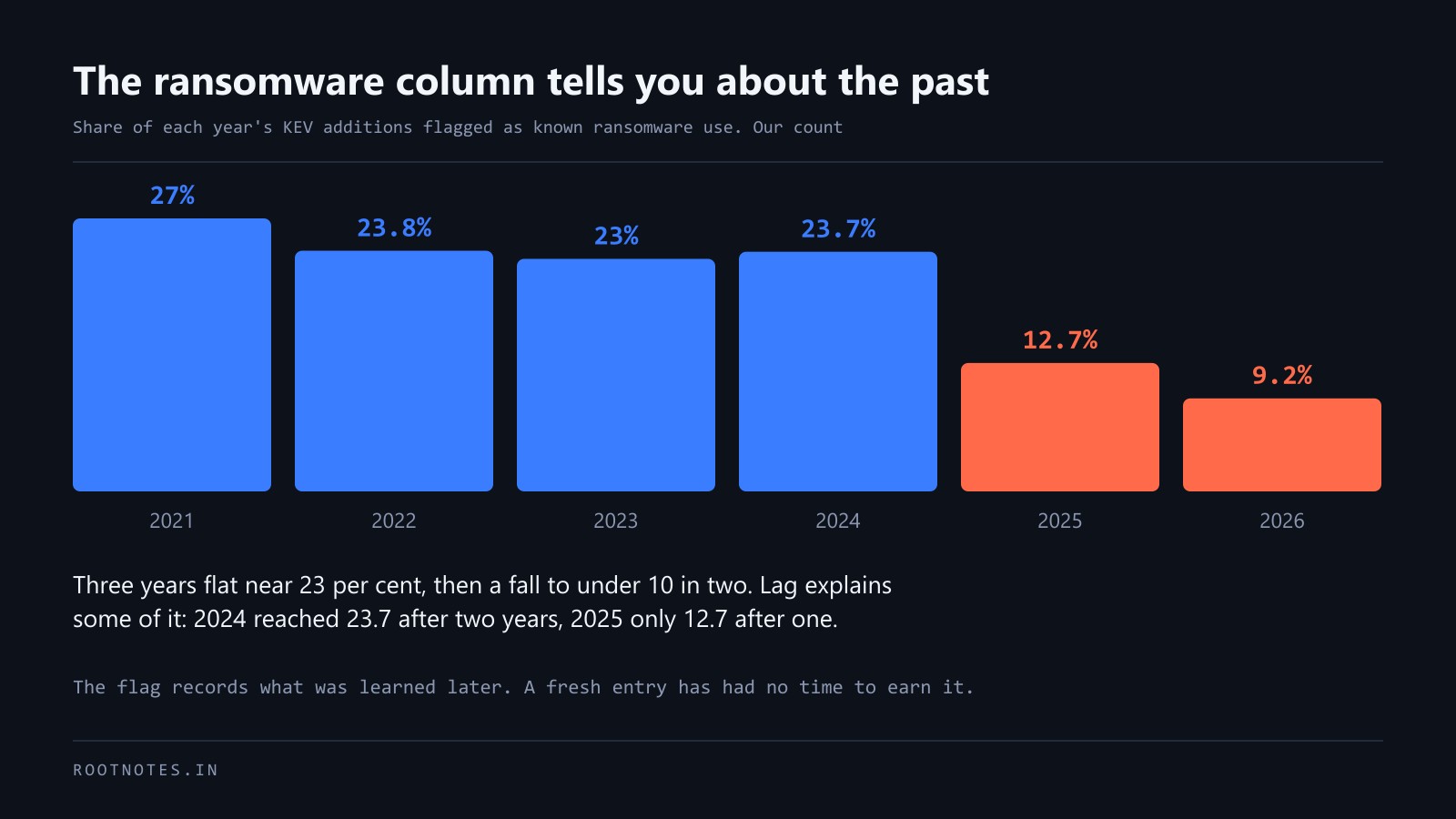
One in four KEV entries used to carry a known-ransomware flag. This year it is one in eleven. Reporting lag explains part of that and demonstrably not all of it, which makes the field useless for the thing people use it for.

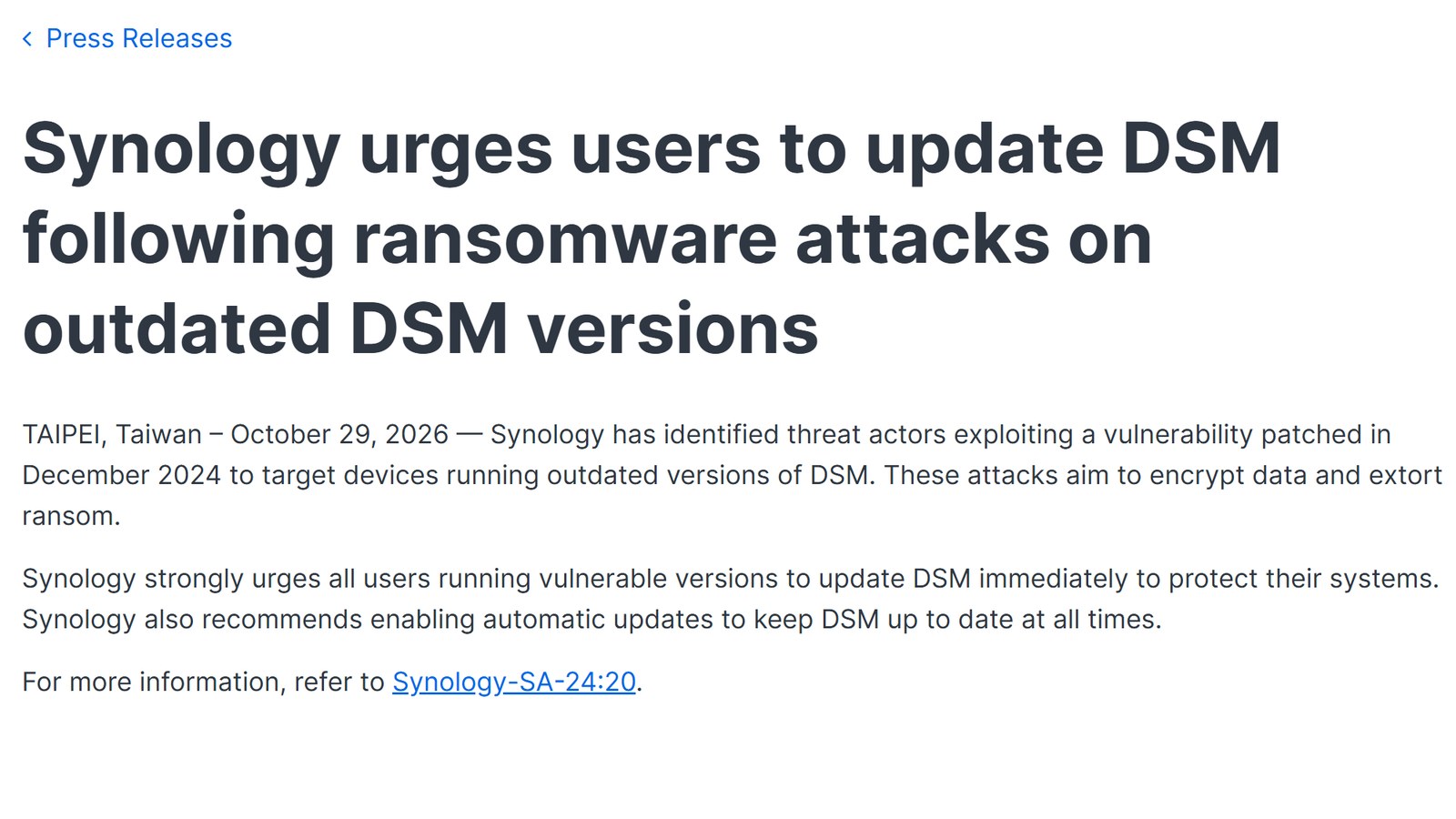
The notice is four sentences long. No CVE, no versions, no count, no malware name. Meanwhile Synology has never had a single entry in the federal catalogue of exploited vulnerabilities.
Talos published its Q3 2026 incident response trends on 29 October. Insufficient logging led the weakness list at over 40 percent of engagements, ahead of credential management and MFA gaps, both on 33 percent.
Talos published NIK C2 on 29 October. If the operator supplies no key, the implant reads OPENAI_API_KEY from the infected machine, so the inference is billed to the victim and the provider's logs point at the victim.
CVE-2026-41709 lets an administrator run operations that are never logged. Broadcom rates it Low. It was added to the catalogue on 28 October, due 11 November, and the patch has been out since July.
Edward Dubrovsky is charged with threatening to disclose stolen data. Separately, two sources told KrebsOnSecurity that the FBI believes an executive at a US consulting firm helped operate Shinywire. Nobody at that firm has been charged or named.
ReliaQuest names Qilin and a newer operation called Settra as exploiting a GlobalProtect authentication bypass that Palo Alto disclosed in May. Nothing about the vulnerability is new. What is worth reading is that patching does not close the sessions a forged cookie already opened.
Comparitech's third-quarter ransomware count is the highest it has recorded. Nine out of ten entries in it are unconfirmed claims posted by the gangs themselves, which makes the number a measure of how much they are claiming as much as how much they are doing.
The owner of MonsterCloud, a firm that sold ransomware recovery as an alternative to paying, has been charged with wire fraud. The indictment alleges he paid the attackers 8 million dollars for keys and billed victims 19 million. He has pleaded not guilty.
CloudSEK documents a Gentlemen ransomware affiliate who wired Model Context Protocol into his attack chain as an execution channel, reached every victim through stolen CI/CD secrets, and published the proceeds on his own leak site rather than the gang's. The investigation started with an open directory he left unauthenticated.
Operation KillSwitch, led by Hamburg police with Europol and Eurojust, searched eight properties in four countries on 30 September and made three arrests. The suspected administrator is a 16-year-old Romanian national detained in Alicante. The age is the headline; the service model is why that job could be held by a teenager.
The 2026 Digital Defense Report, covering July 2025 to June 2026, says attackers are collecting the benefits of AI first. Underneath that headline are three numbers that do not need AI to explain them: nearly 40,000 CVEs in six months, a weaponisation median well below 24 hours against 30 to 60 days to remediate, and a 2020 vulnerability still responsible for most detections among the top five.
ThreatLabz's 2026 report says ransomware attacks rose more than 275% in the year to March, with 896.2 terabytes stolen and 328 million dollars in traced payments. In the same release, the number of victims named on leak sites fell 3% to 7,366. One figure is Zscaler's own telemetry of attempts; the other is what criminals chose to publish.
Aurora used the AI coding assistant Cursor to plan intrusions in Russian — AD CS exploitation, NTLM relay, domain enumeration — while instructing it to exclude CIS address ranges and domains. More than 20 organisations across nine countries between April and July. Also: Cursor is made by Anysphere, not SpaceX, whatever you are about to read elsewhere.
Berlin's state network was breached on 7 August and data flowed out until departments were disconnected on the 14th. The governing mayor says the state is being blackmailed and will not pay. The attackers claim 5.79 terabytes and 1.44 million files. Berlin has published no figures of its own, which leaves one source for every number in circulation.
Qilin listed the Bureau of Alcohol, Tobacco, Firearms and Explosives on its leak site on 26 August. The ATF confirmed an intrusion into a standalone system it disconnected, and says its mission is unaffected. It also confirmed that senior Justice Department officials designated the event a major incident — a federal threshold with a definition.

Days after the leak, an ISO began circulating claiming to be the leaked build. Testers report it is 99.99% empty zeroes padded around roughly 50KB of malware, and that the installer whitelists the entire C: drive in Windows Defender before it runs. The file size was the disguise: 113GB is what a real game looks like.
Marcus Hutchins at Expel picked apart SynkLoader, pushed through Microsoft Teams by attackers posing as the IT help desk and hosted on Azure so the download looks legitimate. Its PhishLocker module paints a convincing Windows 11 lock screen to harvest the password. It is a borderless full-screen app, and Alt+Tab exposes it.
WMIC is not vulnerable. It is a signed Microsoft binary that does exactly what it says, which is why ransomware uses it to delete shadow copies, uninstall antivirus and add Defender exclusions. Deprecated in 2016, finally gone from Windows 11 24H2 and 25H2 — a decade, because you cannot patch a tool that works.
A joint CISA, FBI and HHS advisory puts Medusa past 500 US critical infrastructure organisations as of April 2026, up from 300-plus in March 2025. The number that explains the growth is not the victim count: it is the $100 to $1 million the operation pays initial access brokers.
CVE-2026-12569 in PTC Windchill and FlexPLM is in CISA's exploited catalogue, and ReliaQuest has pulled apart the JSP implant Clop is dropping through it. One command decrypts the LDAP manager password out of the keystore, which turns a PLM compromise into a directory compromise.
Ransom Busters says it has spent three years breaking into ransomware operators' servers and can get your files back. GuidePoint responded to two of these incidents and found the same backdoor password, the same attacker hostname and the same toolkit in both — which points somewhere much less heroic.
Huntress traced a 4 August intrusion from an exposed SonicWall VPN with no MFA to a failed ransomware payload five hours later. The files were already in the attacker's S3 bucket. Defender quarantined akira.exe after the reboot, too late to matter.
Two law firms, an equine hospital, a mental health charity and three metal companies, published in batches with a two-day gap between attack and leak. It shares a name with Microsoft's Storm-1175, which is a different actor entirely.
CVE-2026-45659 was patched in May, flagged as exploited on 1 July with a three-day federal deadline, and marked as used in ransomware on 11 August. Of 8,500 SharePoint servers exposed online, 200-plus remain vulnerable.
Microsoft's analysis describes two Polygon wallet addresses holding proxy URLs and leak-blog posts, with negotiation over Session. There is no hosting provider to serve, because there is no hosting.
Microsoft attributes StormEncryptor, a new C++ locker, to the China-linked group. Initial access was likely CVE-2026-18577 in N-able N-central, which is itself a bypass of the earlier fix. CISA has both flagged as exploited.
51 victims since April 2025, mostly outside North America, exploiting a 2024 Schneider Electric flaw and a 2025 Fortinet one. The advisory is worth reading for what it says about which patches actually matter.
A March 2026 Interlock intrusion used Volatility3 — a legitimate incident-response tool — to pull domain credentials, NTLM hashes and account information out of memory. The rest of the chain was a ClickFix lure and PowerShell.
Sophos tracked STAC4749 across dozens of North American organisations between February and June 2026. Attackers used external Teams accounts and IT-themed personas to talk their way into remote access, then deployed a modular backdoor and, in at least three cases, Chaos ransomware.
Volexity says a threat actor it tracks as UTA0533 is harvesting credentials from compromised SonicWall appliances, and researchers note INC Ransomware has picked up its pace since the start of August.
Explore the latest cybersecurity threats in 2026 including AI-powered attacks, advanced ransomware, phishing 2.0, and identity-based breaches. Stay ahead with deep research insights.
Attack volume jumped nearly 20% month over month. Qilin alone accounted for 372 incidents across Europe, hitting 26 of 31 countries analyzed.