There is no PC version, and that is the rule
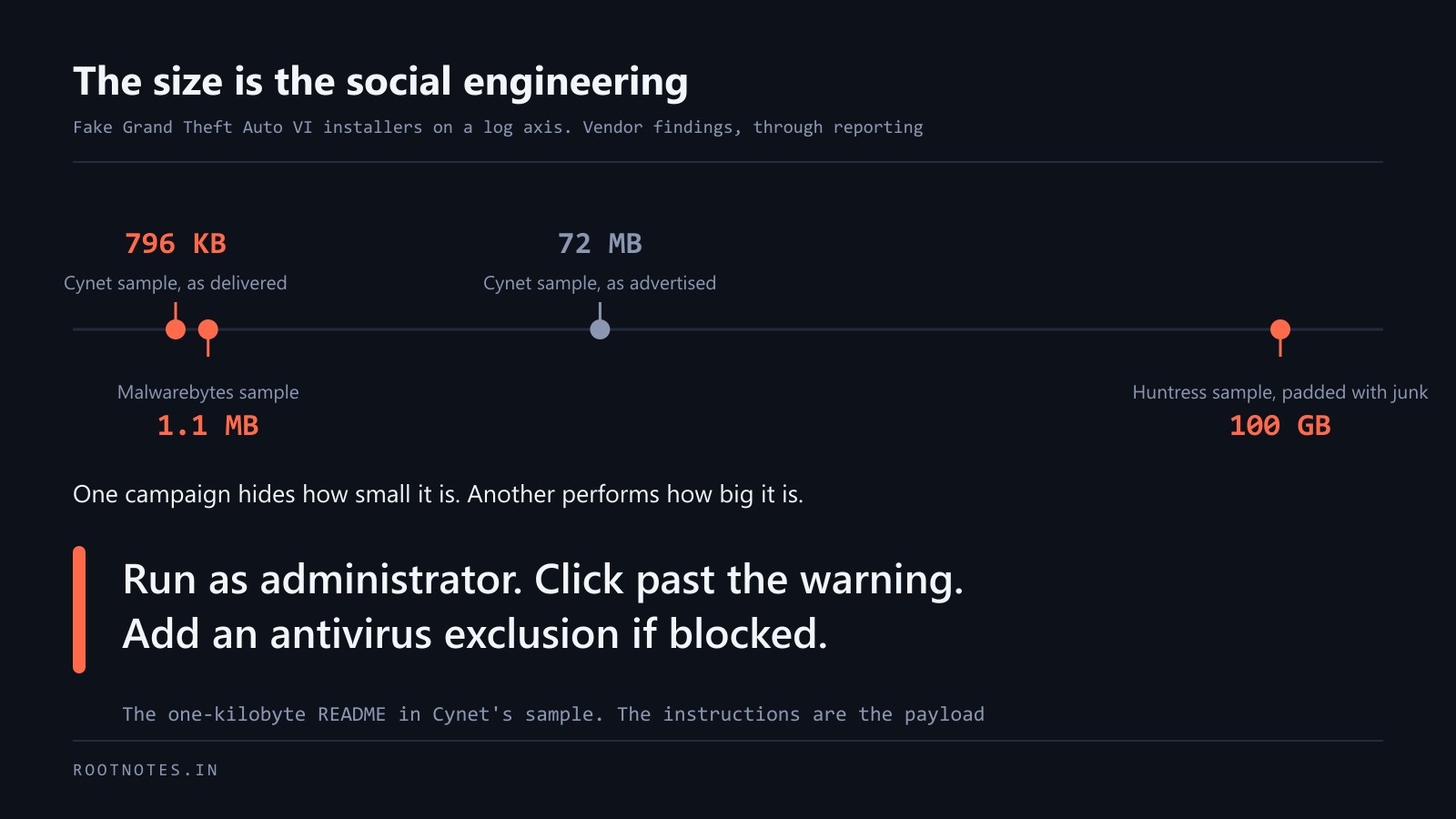
Grand Theft Auto VI shipped on 19 November for consoles only. That one fact makes every Windows installer offered for it malicious, with no exceptions — and security almost never gets a rule that clean.

grep -rl "infostealer" ./articles

Grand Theft Auto VI shipped on 19 November for consoles only. That one fact makes every Windows installer offered for it malicious, with no exceptions — and security almost never gets a rule that clean.

Grand Theft Auto V shipped in September 2013 with no PC version, and a fake PC torrent appeared immediately. It installed a different video game. The 2026 version of that file takes everything you own.
Talos published VOLTA on 31 October. It sends the victim's stolen life to a model and asks for a ranked dossier, and when the model declines it reads the refusal and moves to the next provider in the chain.
An attacker with a hijacked contributor account swapped the files attached to releases going back several versions, for about 94 minutes. Pinning a version does not help when the artefact behind the version can be replaced.
Apiiro counts 17,610 GitHub repositories in the revived FakeGit campaign, more than double July's figure. The scale did not come from mass registration: in about 34 hours the operator re-pointed repos that were already there, and in 97 percent of sampled commits the only thing touched was the README.
Checkmarx has documented an npm campaign running since August 2023 that delivered a remote access trojan and an information stealer through twelve packages. What kept it alive is not stealth. It is that the advisory databases security tooling reads never caught up, and three of the packages are still there.
ANSSI's incident report on the DGFiP, published on 29 September, describes several dozen agent passwords stolen from machines the agency does not manage, sensitive portals with no multi-factor authentication, and a messaging tool scraped on three days in June and July. Nobody noticed until the attacker posted about it on a forum on 12 August.
A 7GB infostealer dump from 5,871 machines across 162 countries held 44,791 unique JSON web tokens, 555 of them for AI services. A replayed token logs an attacker in without logging in — no password, no second factor. The MFA worked. It was never in the path.
GitGuardian found a variant of the npm worm checking 469 locations across developer environments for credentials, up from 189. That number counts places it looks, not credentials it found — and what was added is the interesting part: CI/CD tooling, cloud configuration, and AI tool settings.
JSCeal steals cookies from Chromium browser profiles and reconstructs the session to reach a victim's Google account. That is being written up as bypassing Google authentication. It is not — no authentication mechanism is defeated, and the difference decides whether you go looking for an auth fix that does not exist.